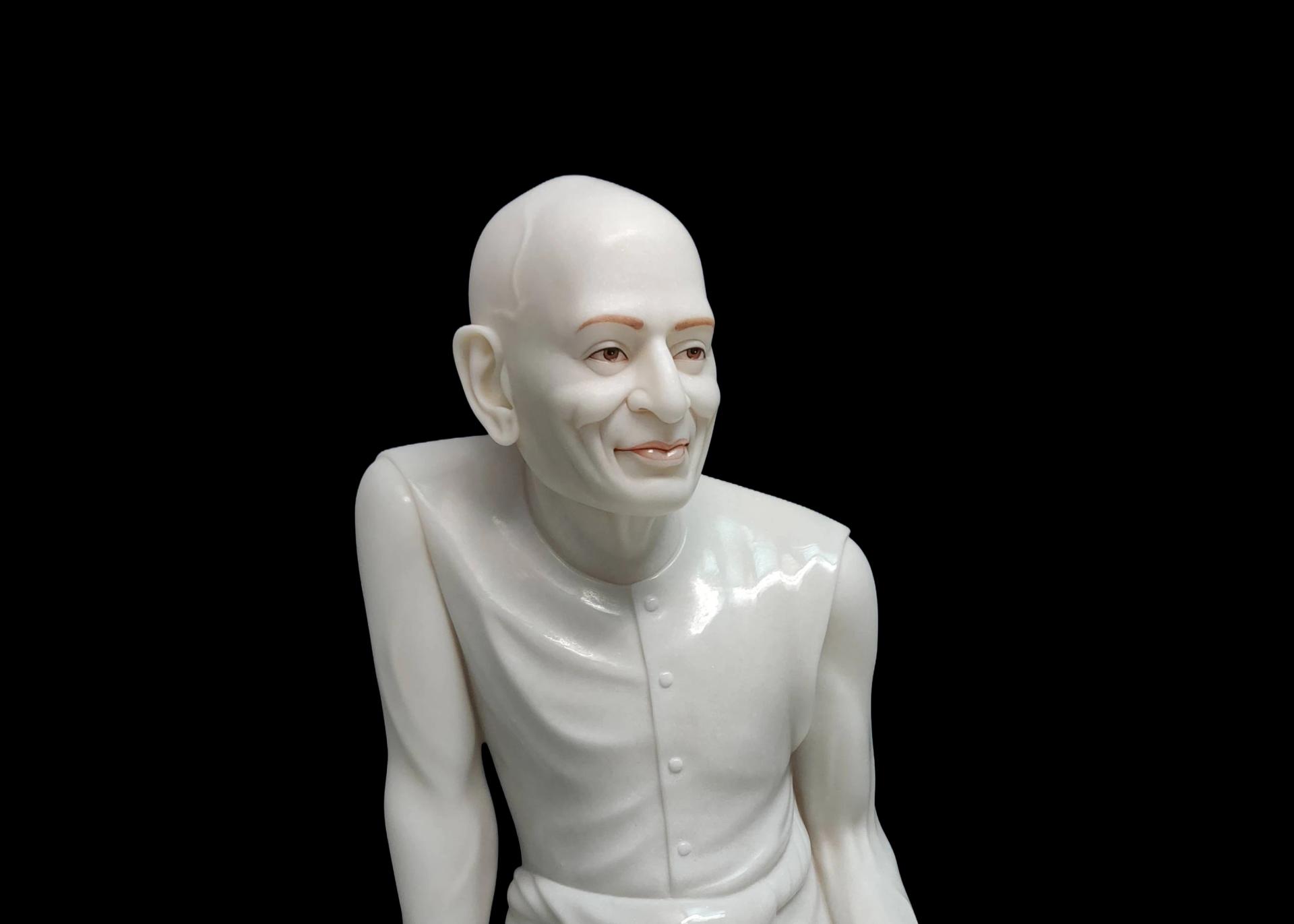
Today there are hundreds of shops and workshops selling marble moorti, and from a distance every statue looks good. In a photograph a decent moorti and an excellent moorti can look almost the same. But anyone can cut a block of marble into the shape of a deity. The real work of an artist, the difference that decides whether the moorti gives you darshan or just stands there like a decoration, is in the details. Our family has been carving marble in Jaipur since 1921, and this is how we ourselves judge a moorti. Use these 12 signs and you will be able to tell good work from average work, even if you are not an expert.
1. Start With the Hands — The True Test of an Artist
If you check only one thing, check the hands. Hands are small, thin and full of detail, and in marble they are the most difficult part to carve because every cut of the chisel is final and thin stone breaks easily. A rushed or unskilled worker simplifies the hands, and a mould or machine blurs them. When the hands are carved properly, it tells you the whole statue was made with patience.
2. Look at Every Finger
In a well-carved moorti each finger is clearly separate, with a natural thickness, a believable curve and visible joints. There is a clean gap between the fingers, and the fingertips and nails are shaped. In poor work the fingers look swollen, stuck together like a mitten, or the gap between them is only a shallow line. Also check the thumb and its position, and how the palm curves. Hold your phone camera close and zoom into the hands, and ask the seller for close-up photographs from the side as well, not only from the front.
- Fingers separate, with clear gaps and visible joints
- Natural thickness, neither swollen nor too thin and fragile
- Fingertips and nails shaped, not blunt
- Wrist, palm and thumb look like a real hand
3. Check the Mudra and What the Hand Holds
Hand gestures in a moorti are not decoration, they have meaning: the blessing hand (abhaya or varada mudra), the folded hands of devotion, the hand that holds a gada, flute, trishul, lotus, modak or bow. See that the gesture is correct and clear, and that the fingers actually wrap around the object they hold instead of the object looking stuck on to the palm. A knowledgeable artist gets these right because he knows the deity and the iconography, not only the shape.
4. Study the Face — the Darshan
The face is where a devotee connects with the moorti. Look at it in natural light from the front and from the side. The two eyes should be equal and symmetrical, the eyelids should be shaped, and the gaze should be calm and inward. The nose bridge should flow naturally into the brows, the lips should be soft and relaxed, and the cheeks and chin should have gentle planes that change softly in the light. The expression should be peaceful and compassionate, not blank, not smiling like a cartoon, and not harsh. If the face looks flat, stamped or the same as ten other statues in the shop, it is probably not an artist's work.
5. Check the Proportions
Indian sculpture has its own system of measurement, called tala-mana, in which the proportions of the whole body are worked out in relation to the length of the face. You do not need to know the formula. Just look at the balance: head to body, length of arms, size of hands and feet, and the position of the shoulders. A statue with a big head and a small body, hands that are too short, or a stiff posture shows weak training. A balanced, graceful standing or seated posture shows a skilled hand.
6. Look at Jewellery, Crown and Clothes
Good carving has depth. The necklace, bracelets, armlets and crown should stand out from the body with clear edges and visible undercut, so light and shadow play on them. The folds of the garments should have depth and flow like real cloth, not just shallow lines scratched on the surface. Repeating patterns such as beads, petals and borders should be even and crisp. In poor work, the jewellery looks flat like a sticker and everything blurs into one smooth surface.
7. Check Feet, Toes and the Base
Many sellers skip the feet. See that the toes are defined, the ankles are natural and the feet sit firmly on the base. If there is a lotus pedestal, the petals should be sharp, equal in size and neatly arranged. The base must be level, so that the moorti stands steady without wobbling, which also matters for safety in a home with children.
8. Check the Finish and the Joints
The polish should be even and soft, with no scratches, patches or wax or filler marks. Large or complex moorti sometimes have parts such as arms, hands or crowns carved separately and joined. This is acceptable when the joint is tight and invisible, but poor work shows seams across hands or arms, or uses filler that shrinks or changes colour with time. Ask the maker which parts are joined and how. A joint on a thin part like a hand or a trunk, if poorly done, is where a statue will break first.
9. Confirm That It Is Natural Marble
The finest carving is wasted if the material is not what you were told. A cast piece made of dust marble and resin cannot have the sharp undercuts of a hand-carved stone, and it is not a natural material for worship. Ask which marble is used, ask to see the unpolished base, and read our guides on natural marble vs Korean and dust marble and how to identify an original Makrana marble moorti.
See the Difference in Our Work
Every moorti at Ram Krishna Moorti Art is carved by hand from natural marble, with special attention to the hands, face and ornaments. Send us your requirement on WhatsApp, and we will share close-up photographs and videos of similar work, so that you can judge for yourself.
Frequently Asked Questions
How do I know if a marble moorti is carved by a real artist?
Look at the hands and fingers first, then the face, jewellery, feet and the back of the statue. A real artist gets small details right: separate fingers with visible joints, calm symmetrical eyes, deep folds and finished back and sides.
Why are the hands the most important part of a moorti?
Hands are thin and detailed and every chisel cut in marble is final, so they are the hardest part to carve. Weak or rushed work shows quickly in the hands.
Should I choose the cheapest marble moorti?
Not on price alone. Compare the carving quality, the material and what is included. A far lower price usually means thinner carving, lower-grade stone or a cast piece.
Can I visit your workshop before ordering?
Yes. You are welcome to visit our workshop at Surya Nagar, Gopalpura Bypass, Jaipur. Please message us on WhatsApp before you come, or ask for a video call to see the work.
Looking for a genuine hand-carved marble moorti?
Share the deity, size and placement with us on WhatsApp and get reference photos with a transparent quote from our Jaipur workshop.
Chat on WhatsApp