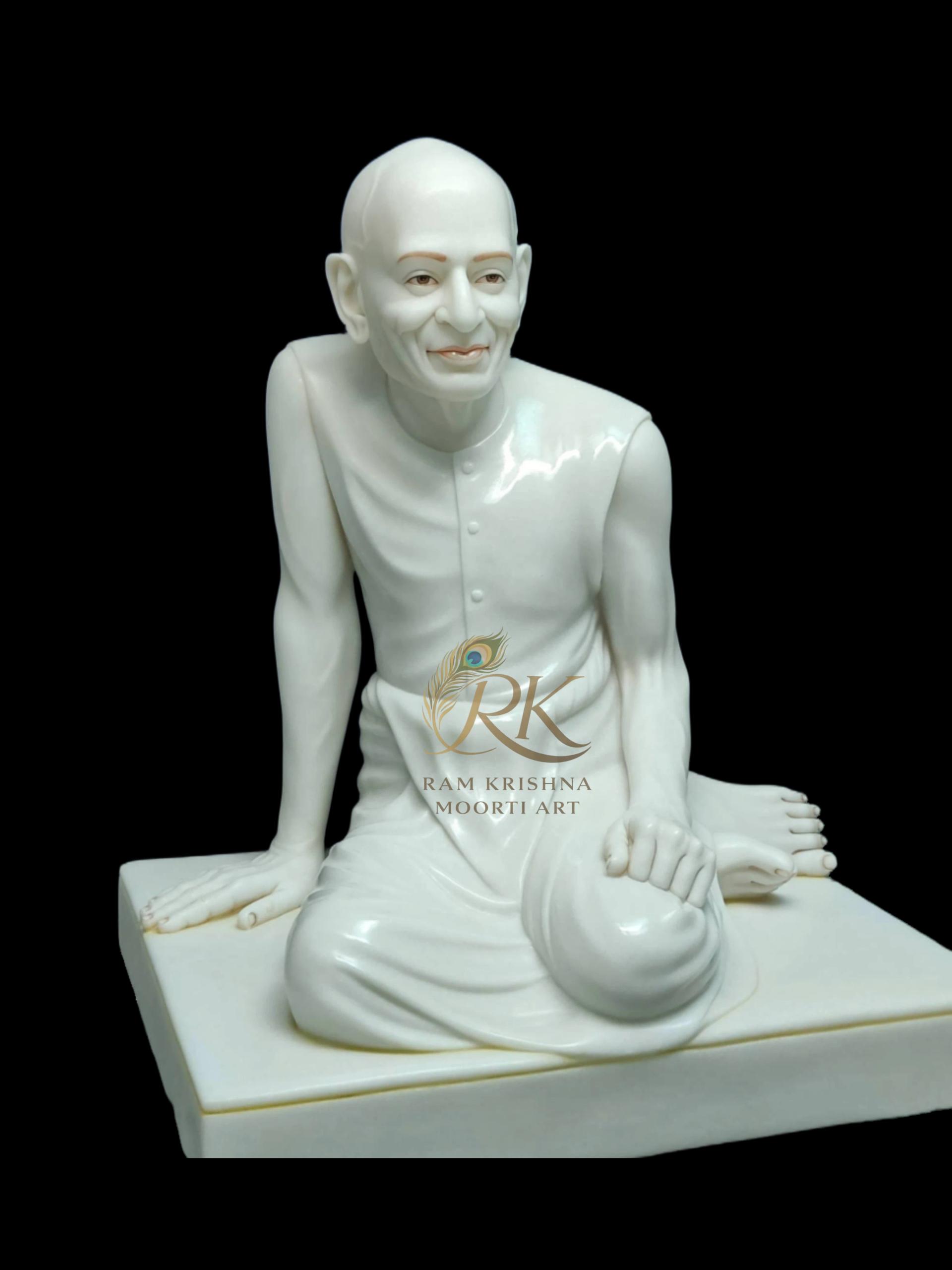
Today many shops and online sellers offer very smooth, bright white statues under names like Korean marble, dust marble, artificial marble or cultured marble, at a much lower price than a real marble moorti. In photographs they look almost the same, so many families ask us: can I keep this in my pooja room? Our family has been carving natural marble in Jaipur since 1921, and our honest answer is this: a dust marble piece can be kept as a decorative show piece, but a moorti that you worship every day, and in which pran pratishtha is done, should be made of natural stone. In this article we explain what these materials really are, what problems they have, and why tradition prefers natural marble.
What Is Korean Marble or Dust Marble?
Korean marble, dust marble, cultured marble and artificial marble are different trade names for the same family of man-made material. It is made by mixing marble dust or crushed stone chips with polyester or acrylic resin and colour pigments. This liquid mixture is poured into a mould, allowed to set, and then polished or finished with a thin glossy resin coat. So it is a cast, factory-style product. It is not a stone taken from a mountain and carved by a sculptor, and the smooth white shine you see is largely the resin, not the stone.
What Is Natural Marble?
Natural marble such as Makrana white, Vietnam white or Bheslana black is a real rock, formed inside the earth over millions of years. A block is cut from the quarry and the artisan carves it by hand with chisels, removing stone little by little until the form of the deity appears. Nothing is mixed into it and nothing is poured. The material you worship is the same stone that came from the earth, which is why marble has been the heart of Indian temple building for centuries.
Why Natural Stone Is Preferred for Puja
In our tradition a murti is not just a decorative statue. It becomes a murti when the deity is invoked into it through pran pratishtha. The classical texts, including the list in the Shrimad Bhagavat Purana, describe sacred images as being made of natural materials such as stone (shaili), metal (lauhi), wood (darumayi), clay and similar substances. A resin-and-dust composite made in a mould does not belong to any of these natural categories. This is why temples across India, from Rajasthan to the south, use carved natural stone, and why marble is the stone of choice in north Indian temples: it can take daily abhishek and puja without eroding. Many pandits and acharyas therefore advise families to install only natural stone or metal in the home mandir. Practices differ between families and sampradayas, so please confirm with your own pandit or guru. But if you ask us as makers, our answer is clear: for worship, choose natural stone.
The Real Problems of Dust Marble Moorti
Apart from the religious point, a dust marble statue has practical problems that show up with time. The photographs at the time of selling never show these, because they appear after months and years of use. These are the problems you should know about before you spend your money.
- Yellowing with time: the resin that binds the dust is generally not stable in sunlight and ages with light and heat. White pieces slowly turn yellowish or dull, especially in a mandir near a window or sunlit area. A white moorti is chosen for its purity, so a yellowed one defeats the purpose.
- Heat of puja: a daily puja means a diya, ghee lamp, camphor aarti and incense very close to the moorti. Resin is sensitive to heat and can discolour, warp or develop fine cracks over time, and soot or burn marks are hard to remove. Natural marble is a stone and handles the heat of puja with no trouble.
- Shine that scratches away: the glossy surface of cast pieces is often only a thin resin layer. Once it is scratched or dulled by cleaning, it is very difficult to bring back the original shine. Natural marble can be re-polished and restored by an artisan again and again.
- Chips and cracks cannot be repaired properly: thin parts like hands, fingers, trunk, crown and ornaments are the weak points in any statue. When a cast piece chips, the repair is done with filler and colour and it usually stays visible. A natural marble piece can be repaired and re-polished far more cleanly.
- Cleaning and abhishek: daily water, milk, panchamrit, Gangajal, chandan, kumkum and haldi plus cleaning agents can stain or dull resin coatings over time. Natural marble can be washed, cleaned and restored.
- No hand of the artist: most dust marble statues come from moulds, so thousands of pieces have the same face and the same pose. Fingers are often joined together, details are shallow, the eyes and lips look soft or blank, and there is no deep undercutting. A hand-carved moorti has a living expression that a mould cannot copy.
- Not natural, so not for pran pratishtha: this is the most important point for devotees. A moorti that you invoke and worship should be a natural material, as the tradition describes.
- No lasting value: a natural marble moorti stays in the family for generations and is passed on. A cast piece ages, yellows and gets discarded, so you may end up buying again and again, which costs more in the long run.
Fair Note: Quality of Resin Varies
Not every cast piece is equally poor. A better-quality resin and coating will last longer than a cheap one, and some pieces stay fine for many years. But no matter how good the resin is, it remains a man-made composite. It will never become stone, never be carved by a sculptor, and never be a natural material for worship. That is the reason we do not make or sell it for puja.
Where Dust Marble Can Be Kept
If you simply want an attractive decorative figure for a living room shelf, a garden corner or a gift that will not be used for worship, a dust marble piece can serve as a budget show piece. Our only request is that you decide clearly beforehand: is this for display, or is this for puja? If it is for puja, please choose natural marble.
- Show piece, decorative display: acceptable
- Main moorti for daily puja and pran pratishtha: choose natural marble
- Temple and mandir installation: choose natural marble
Natural Marble vs Dust Marble: Side-by-Side
The points below summarise the practical differences you will notice.
- Material: natural marble is pure stone carved by hand; dust marble is marble dust mixed with resin and cast in a mould
- Carving: a natural moorti is chiselled by an artisan so each piece is unique; cast pieces come from one mould and look identical
- Grain and veins: natural stone has irregular, one-of-a-kind grain; cast material looks uniform or repeats the same pattern
- Feel: natural marble is cool and dense to touch; resin-based material often feels warmer and more plastic-like
- Heat of diya and camphor: natural marble is unaffected; resin is sensitive to heat
- Sunlight and age: good natural marble stays white for decades; resin can yellow and dull
- Repair and polish: natural marble can be re-polished; resin coating is very hard to restore
- Pran pratishtha: natural stone is the traditional material; cast composite is treated as decorative
- Life: natural marble lasts for generations; cast pieces age much sooner
- Price: natural marble costs more because of the block, labour and skill; cast pieces cost less because of mass production
How to Avoid Being Sold the Wrong Material
A polished cast piece can look very similar to natural marble in a photograph, and some sellers do not say clearly what the statue is made of. Ask directly: is this natural Makrana or Vietnam marble, or is it marble dust? Ask to see the unpolished base or back of the statue, where natural crystals are visible. Ask where the block came from. Ask for the material to be written on the bill. A genuine maker will answer happily. Read our guides on how to identify an original Makrana marble moorti and how to find the best marble moorti in the market for a full checklist.
Our Promise at Ram Krishna Moorti Art
Every moorti that leaves our Jaipur workshop is carved by hand from natural marble, and we tell you exactly which marble is used: Makrana white, Vietnam white or Bheslana black. For custom orders we can show you the block before carving begins and share progress photographs at every stage. WhatsApp us your requirement and we will guide you honestly on material, size and budget.
Frequently Asked Questions
Is Korean marble natural marble?
No. Korean marble, dust marble, cultured marble and artificial marble are man-made materials made from marble dust or chips mixed with resin and pigments and cast in moulds. Natural marble is real stone quarried from the earth and carved by hand.
Can I keep a dust marble or Korean marble moorti in my pooja room?
As a decorative show piece it can be kept in the home. For the main moorti that you worship daily and in which pran pratishtha is done, tradition prefers natural stone or metal. Please also confirm with your family pandit.
Does dust marble yellow with time?
Resin-based material is generally not stable in sunlight and heat and tends to yellow or dull with age, especially in sunlit places. Good natural marble keeps its white colour for decades.
Can I light a diya and camphor near a dust marble statue?
Resin is sensitive to heat, so regular diya, camphor aarti and incense close to the statue can discolour or damage it over time. Natural marble is a stone and handles it comfortably.
Which marble is best for a Hindu god moorti?
Makrana white marble is the most preferred for its pure white colour and fine grain. Vietnam white marble is also an excellent natural option, and Bheslana black marble is chosen for Shani Dev, Shivling and dramatic Veer Hanuman statues.
Why is a dust marble moorti cheaper?
Because it is cast in moulds in large numbers using marble dust and resin. A natural marble moorti costs more because of the block of stone and the days of skilled hand-carving.
Looking for a genuine hand-carved marble moorti?
Share the deity, size and placement with us on WhatsApp and get reference photos with a transparent quote from our Jaipur workshop.
Chat on WhatsApp