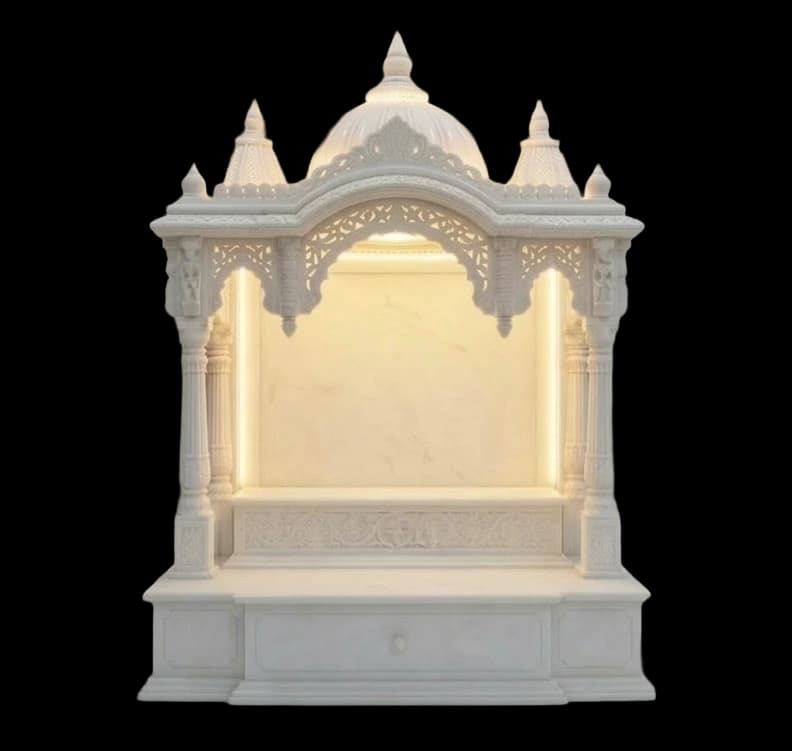
Many people ask us before ordering: which moorti should I keep in my home mandir, and is there any rule? Hindu traditions are rich and varied, so you will hear different advice from different families and gurus. The points below are commonly followed beliefs shared by many families and pandits. They are meant as a general guide, and your own family tradition and pandit should have the final word.
Start With Your Ishta Devta and Kuldevta
The simplest rule is to keep the deity you feel connected to. Most families keep their kuldevta or kuldevi and ishta devta in the main mandir. Popular choices for homes are Ganesh Ji, Laxmi Ji, Radha Krishna, Shiv Parivar, Ram Darbar, Durga Maa, Hanuman Ji and Saraswati Maa. You do not have to keep every deity, one or two with true devotion is better than a crowded shelf.
Size of the Moorti
The principal moorti in a home mandir is usually kept modest in size, while larger and taller moorti are generally placed in temples. Some traditions give specific size limits for home idols, but they differ from family to family. In our experience, most homes choose between 6 and 24 inches, and larger sizes for dedicated pooja rooms or home temples. Please check with your pandit if you follow a specific tradition.
Posture and Expression
Choose a moorti with a calm, benevolent and graceful expression. Many families prefer a standing, seated or blessing posture for home worship, and prefer to avoid very fierce or angry postures for daily home puja. Warrior forms like Veer Hanuman are very popular at entrances, gyms and offices, while the Bhakt Hanuman pose with folded hands is more common inside the home.
Commonly Followed Do's
These are the most commonly followed practices among families.
- Keep the moorti clean, and offer fresh flowers or at least a diya every day
- Place the moorti on a clean seat or pedestal, not directly on the floor
- Keep the area around the mandir tidy and uncluttered
- Choose natural stone, marble or metal moorti for the main worship space
- Install a new moorti on a day chosen with your pandit
Commonly Followed Don'ts
Again, traditions vary, but you will often hear the following advice.
- Avoid keeping a broken, cracked or damaged moorti for worship; many families immerse it respectfully in flowing water and install a new one
- Avoid keeping two Shivlings in the same mandir
- Avoid placing the moorti flush against the wall, leave a little gap
- Many families worship Shani Dev at a temple rather than at home
- Avoid keeping photographs of deceased family members in the same space as deity moorti
Directions and Placement
For the direction, height and placement of the mandir inside the home, please read our detailed Vastu tips for home mandir. The northeast and east are generally considered most auspicious.
Need Help Choosing?
If you are still unsure, tell us about your family deity, the size of your pooja space and your budget on WhatsApp. We have been making moorti for generations and are happy to guide you honestly. We will never push a size or design that does not suit your space.
Frequently Asked Questions
Which god moorti is best for home?
Ganesh Ji, Laxmi Ji, Radha Krishna, Shiv Parivar, Ram Darbar, Durga Maa and Hanuman Ji are the most popular. The best choice is your kuldevta or ishta devta.
Can I keep many moorti in one home mandir?
You can, but it is better not to overcrowd the space. Keep the moorti that you will worship regularly, with enough gap between them.
What should I do with a broken moorti?
Read our guide on what to do with a broken or damaged moorti.
Looking for a genuine hand-carved marble moorti?
Share the deity, size and placement with us on WhatsApp and get reference photos with a transparent quote from our Jaipur workshop.
Chat on WhatsApp